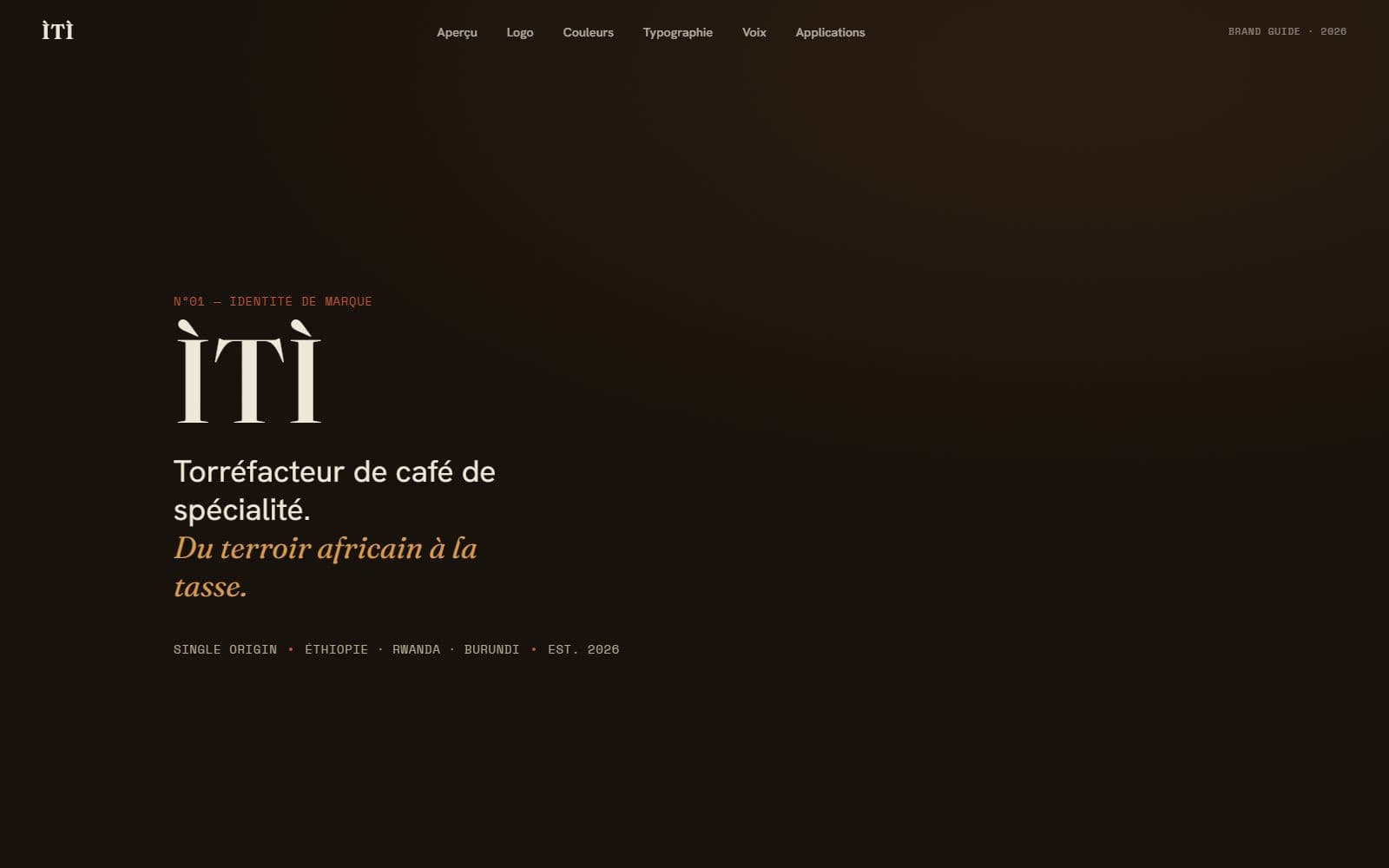
The brief
A specialty coffee roaster in Abidjan, working East African origins — Ethiopia, Rwanda, Burundi — with direct relationships to the producers. The brand had a name, a point of view and nothing else.
The commission was not a logo: it was the document that lets other people produce without getting it wrong. Guidelines are judged the day an outsider opens them.
The constraints
- The guidelines must survive without their author. A printer, a developer, a photographer must find their answer without calling anyone.
- A coffee identity risks cliché: jute sack, close-up bean, brown on brown.
- It has to live on screen as well as on a bag — two media that forgive very different approximations.
The decisions
Navigable guidelines rather than a PDF.
The deliverable is a site in six sections: overview, logo, colours, typography, voice, applications. A forty-page PDF gets read once and then goes stale in a shared folder. A web page opens in three seconds on a phone, at the moment the question comes up.
A voice section ranked equal to the logo.
Most guidelines stop at the visual. This one devotes a whole section to tone — precise, warm, jargon-free — with examples of what gets written and what does not. A brand is recognised as much by how it speaks as by its colour, and that is the part everybody improvises.
Five shades, three families, and not one more.
Espresso, terracotta, golden ochre, olive, pale paper. Fraunces for headings, Hanken Grotesk for body text, Space Mono for data. A restricted system is a system people apply; a palette of twelve shades is a palette people interpret.
The result
Guidelines consultable online covering the logotype and its seal, the palette, the three type families, the manifesto in four pillars — traceable origin, craft, human warmth, transparency — and the applications: packaging, shop, stationery, objects.
What I would do differently
The guidelines show the applications, they do not make them downloadable. A bag template and a set of logos in the right formats, directly available from the page, would prevent most production errors — the ones that come from a file rebuilt by hand by a supplier in a hurry.